The  SMART Future project is based at Chippewa Valley Technical College (CVTC). CVTC is part of the Wisconsin Technical College System and is located in Eau Claire, Wisconsin. CVTC offers associate degrees, certificates, apprenticeships, and other educational opportunities.
Smart Manufacturing and Resources for Transforming the Future (SMART Future) is promoting STEM exploration and education while strengthening the economies of rural areas through training in new manufacturing technologies. By preparing rural high school students for careers in high-growth fields like manufacturing and information technology, SMART Future is advancing new and innovative methods for producing goods, meeting the nation's changing employment needs, and improving educational and earning opportunities for teachers and youth in rural areas.
Through its use of a Mobile Simulation Laboratory, SMART Future is preparing technicians for industrial automation and technology careers and increasing the capacity of rural secondary teachers to provide education in the context of the emerging Industrial Internet of Things (IIoT) and Industry 4.0. The project goals are to expand STEM opportunities and prepare technicians for manufacturing and engineering careers through applied education of IIoT and Industry 4.0 concepts; and increase the capacity of rural secondary teachers to provide instruction in industrial automation. Drawing on industry expertise, SMART Future is providing dual credit for learning STEM principles in industrial automation, including programmable logic controllers (PLCs), microcontrollers, robotics, automated processes, machine-to-machine learning, computer networking and programming, applied mathematics, engineering design, precision measurement, physics, and mathematical logic.
The National Science Foundation's Advanced Technological Education (ATE) program has been funding innovation at two-year colleges for over twenty years. With a focus on the education of technicians for the high-technology fields that drive our nation's economy, and strong partnerships between academic institutions and industry, ATE promotes improvement in the education of science and engineering technicians at the undergraduate and secondary school levels.
To learn more about ATE, please visit the NSF ATE program home page.
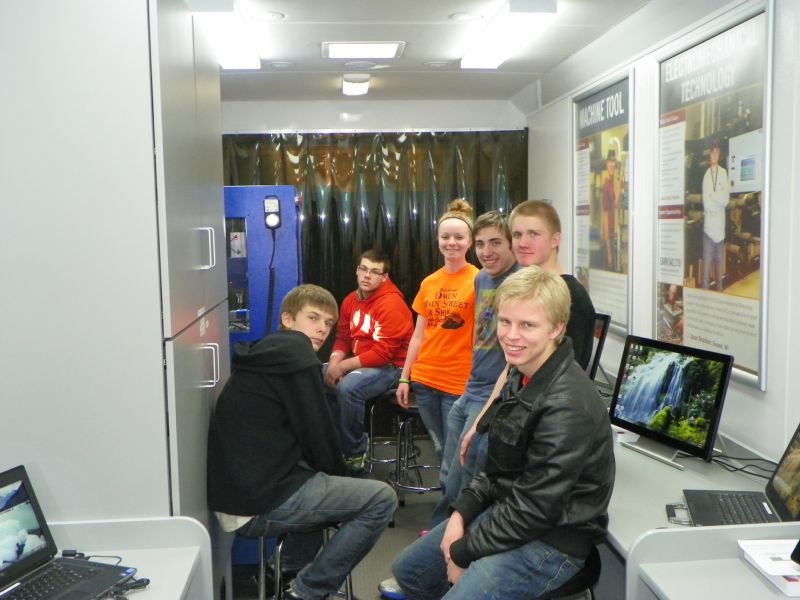
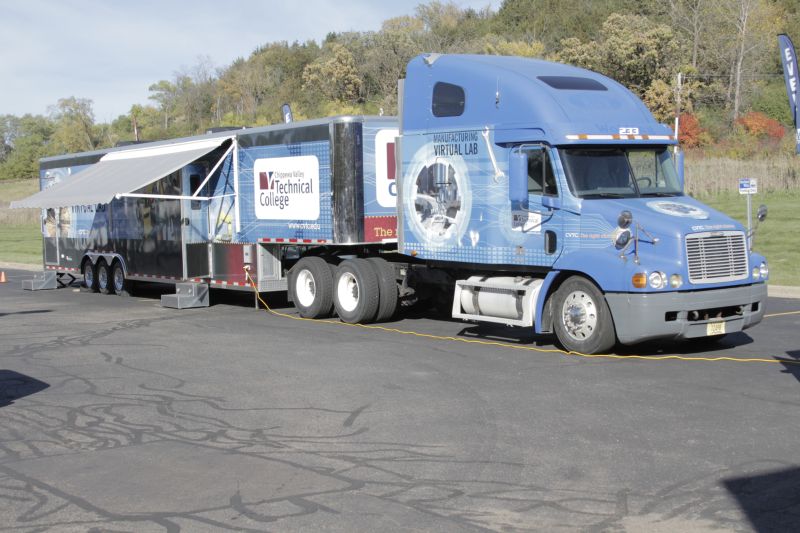
The SMART Future project brings together rural high school technology instructors, technical college faculty, and industry professionals to design and deliver instruction in Industry 4.0, supply chain, and automation concepts via a mobile manufacturing laboratory.
During week-long professional development workshops, high school instructors from four rural Wisconsin schools receive instruction on equipment and simulations. This enables them to deliver learning modules in advanced manufacturing to their students with the assistance of the mobile lab's technician.
When high school students learn in the lab, they gain industry-recognized credentials that help them transition to college or employment. They also receive credit for prior learning to facilitate their acquisition of academic credentials.

