Browse Resources
Instructional Material -- Instructor Guide/Manual
Resources |
|---|
 This four-page instructor guide from Edmonds Community College provides a laboratory activity demonstrating plastic deformation to students. Students observe plastic deformation in polyethylene, apply physical stress to a plastic sheet, and observe the "necking" effect this stress causes. This...
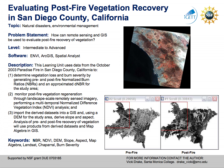 Learning Unit Description:
The Integrated Geospatial Education and Technology Training Project (iGETT) presents a series of Learning Units (LU) designed to incorporate federal land remote sensing data into Geographic Information Systems (GIS) instruction. The Evaluating Post-Fire Vegetation...
 Module Description: The Fire Ecology and Management Series is provided by the Northwest Center for Sustainable Resources and includes six modules. This series “is designed to address both the general role of fire in ecosystems as well as specific wildfire management issues in forest ecosystems.” The...
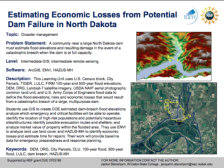 Learning Unit Description:
The Integrated Geospatial Education and Technology Training (iGETT) presents a series of Learning Units (LU) designed to incorporate federal land remote sensing data into Geographic Information Systems (GIS) instruction. This lesson uses GIS and remote sensing...
 This lab, presented by the National Nanotechnology Coordinated Infrastructure, introduces students to the concepts of scale and magnification using a Scanning Electron Microscope (SEM) image of a Blue Morpho butterfly wing. If educators do not have access to an SEM, images are included with the...
 Module Description: The Fire Ecology and Management Series is provided by the Northwest Center for Sustainable Resources and includes six modules. This series “is designed to address both the general role of fire in ecosystems as well as specific wildfire management issues in forest ecosystems.” The...
 "How can I get my students to think?" is a question asked by many faculty, regardless of their disciplines. Problem-based learning (PBL) is an instructional method that challenges students to "learn to learn," working cooperatively in groups to seek solutions to real world problems. These problems...
 Module Description:
This module, from Support Center for Microsystems Education (SCME), provides an introduction to "a systematic approach to solving problems by using a six-step process." The module contains information on approaches for solving both simple and complex problems. Students are...
 This nine-page instructor guide outlines a laboratory activity testing the strength of fibers and fabrics. Students observe the properties of different fibers and fabrics and the differences between natural and synthetic fibers. This activity demonstrates why fibers may be chosen for different...
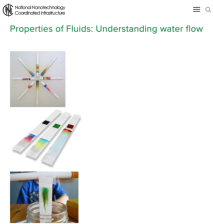 This lesson, presented by the National Nanotechnology Coordinated Infrastructure, covers the properties of water flow. Students will "observe and understand the way fluids interact with a stationary phase for example, chromatography paper." Next, students will create a list of questions they have...
|
| ← PreviousNext → |